Comparing pork appearance from same-dam pigs, with a record of farm hygiene
Biotechno Industry Co., Ltd.
1Purpose of this report
From “how it looks” to business metrics
This report documents differences in pork appearance and changes in farm hygiene observed when pigs from the same dam were divided into a “standard feeding group” and a “Bio Charger A group (0.2% added to feed).” Starting from what can be confirmed in photographs, we aim to connect these observations to numerical and business indicators—carcass results, meat-quality analysis and sales evaluation—in the next stage.
* This report is a record of observations at an actual site. It does not guarantee any effect, and results vary with individual animals and farm conditions.
2Test flow & conditions
Premises of the comparison
Group A
Standard feeding
Group B
Bio A 0.2% added
Common
Same dam, same breed
Cuts
Belly / Loin / Shoulder
Flow
STEP 1Set up groups Standard vs Bio A
STEP 2Feeding Same conditions +0.2%
STEP 3Slaughter & cutting Trim 3 cuts
STEP 4Appearance Record photo findings
STEP 5Quantify (next) Carcass / quality / sales
How we evaluate
First we check appearance visible in photos (redness of lean, contrast between fat and lean, marbling, slicing uniformity). In the next stage we quantify carcass weight, yield, pH, drip loss, cooking loss, color and taste, and connect them to business indicators such as unit price and grade ratio.
3Photo assessment | Belly
Appearance for sliced products; lean–fat contrast
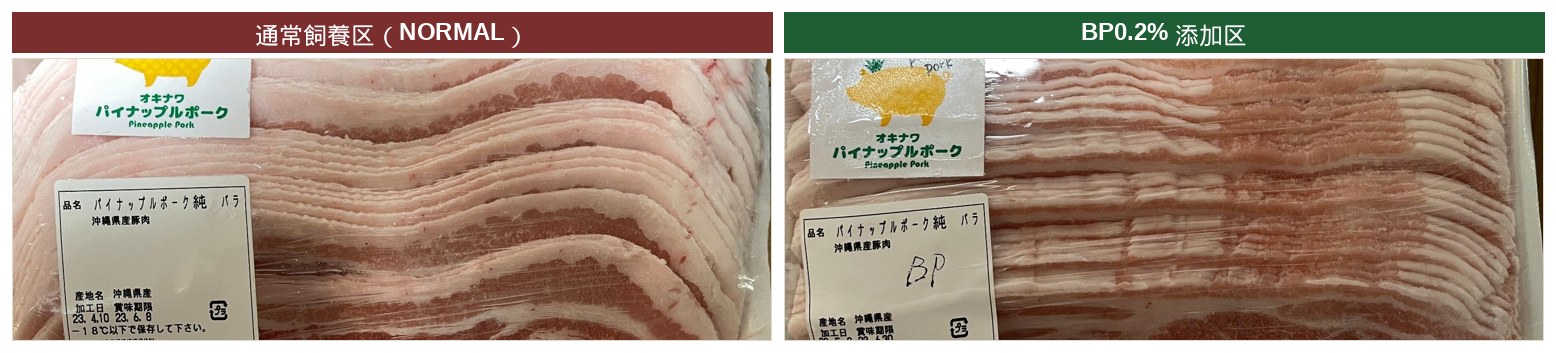
Pigs from the same dam. Left: standard feeding / Right: Bio Charger A 0.2% added.
Appearance findings
The added group shows relatively clearer continuity of lean layers
Boundaries with fat are easier to see, giving a tidier look on the tray
Possible improvement in shelf appearance for sliced belly products
KPIs for next stage: Slicing yield, drip loss, color, fat-layer thickness, store evaluation
* Photos are an actual example at Kamiya Livestock. These are appearance trends and do not guarantee quality, taste or nutrition. Labels are shown as-is.
4Photo assessment | Loin
Redness of lean; loin-eye appearance
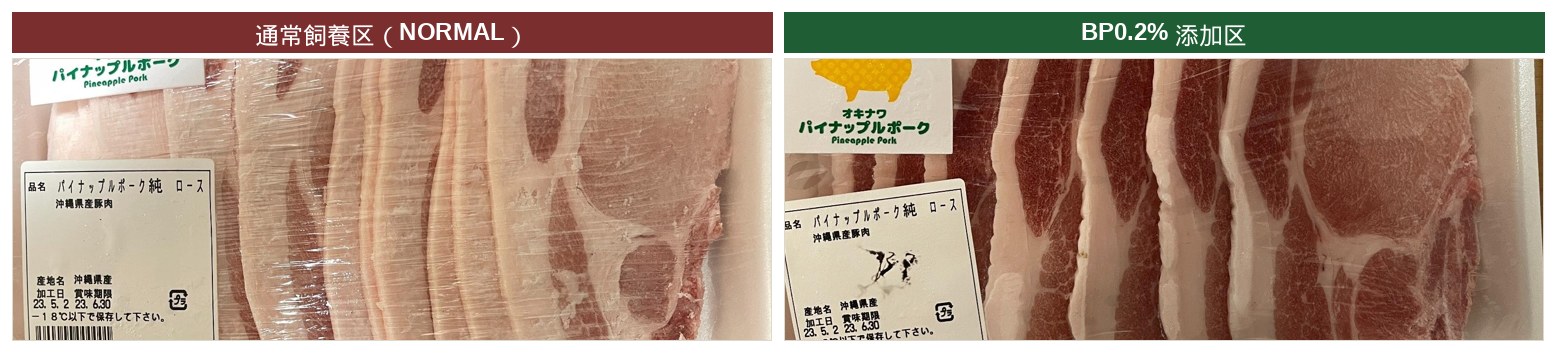
Pigs from the same dam. Left: standard feeding / Right: Bio Charger A 0.2% added.
Appearance findings
The added group shows good redness of lean and a prominent loin eye
Clear contrast with fat covering gives a higher impression of quality
Loin is a cut where consumers and buyers easily judge meat quality
KPIs for next stage: Loin-eye area, backfat thickness, pH, cooking loss, tenderness, sensory evaluation
* Photos are an actual example at Kamiya Livestock. These are appearance trends and do not guarantee quality, taste or nutrition. Labels are shown as-is.
5Photo assessment | Shoulder
Marbling appearance; premium-cut appeal
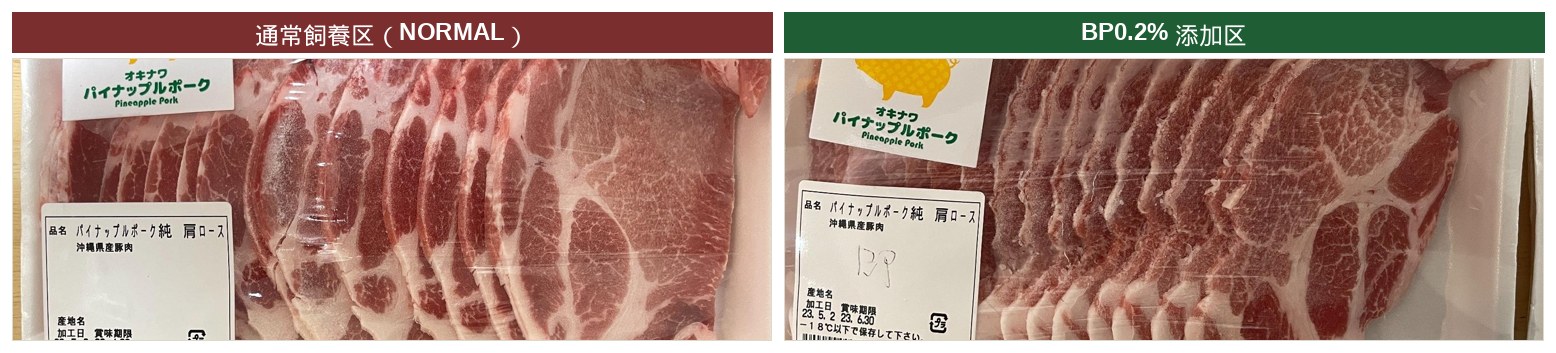
Pigs from the same dam. Left: standard feeding / Right: Bio Charger A 0.2% added.
Appearance findings
The added group shows finer marbling and deeper redness of lean
The texture characteristic of shoulder loin is easier to see
Visible appearance differences in high-value cuts help explain product value
KPIs for next stage: Intramuscular fat ratio, color, fat melting point, taste, shelf life
* Photos are an actual example at Kamiya Livestock. These are appearance trends and do not guarantee quality, taste or nutrition. Labels are shown as-is.
6Voices from the farm — Kamiya Livestock (Okinawa)
Four years of continuous use
Kamiya Livestock has used Bio Charger A continuously for four years. We present the very fact of long-term continued use as one indication of ease of use on site.
“When cleaning the drainage ditches, the eye-stinging pungent odor has decreased, and the work has become much easier.”
“The barn environment has settled down, and the pigs seem to spend their time more calmly than before.”
“Overall management has become easier, and we can fatten the pigs more stably.”
* These are personal impressions of the farm staff and do not indicate or guarantee any effect. Kamiya Livestock can be introduced as a demonstration farm open to visits.
7Discussion & summary
From appearance findings to numbers and business metrics
The appearance trends seen in the photos suggested differences in items related to in-store appearance (product impression), such as redness of lean, contrast with fat and marbling. However, these are only appearance findings and do not quantitatively indicate quality, taste or nutritional value. Going forward, we plan to quantify carcass results, meat-quality analysis and sales data, and to evaluate including business indicators such as unit price, grade ratio, yield and return rate.
Demonstration test plan (proposal)
Same farm, same breed, same age: set up a standard group and a Bio A 0.2% group
Aim for 30+ head per group, repeating across multiple lots if possible
Record feed intake, weight gain, FCR and incident rate at the same time
After slaughter, confirm carcass results, meat-quality analysis and sales evaluation together
Next steps
Design a limited-lot trial → quantify carcass results, meat-quality analysis and economic impact.
* This report is a record of a specific demonstration case and does not guarantee any effect. The appearance and observations described vary by individual animal and by farm environment. For final confirmation of prices, ingredients, etc., please contact each product page or the relevant desk.
Biotechno Industry Co., Ltd. | This report is a record of a demonstration case